Monday, January 5, 2009

Why So Serious?

Copyright 2008, Warner Bros. Pictures

The Producers' Guild announced their nominations for film today, and the usual suspects arrived: The Curious Case of Benjamin Button, Frost/Nixon, Milk, Slumdog Millionaire and....The Dark Knight. I'm not particularly surprised about this, as the five have been relatively solid for a while. Still, I wouldn't cry if both of my favorite films of 2008 ended up as Best Picture nominees. It's been a bland year for film, so the possibility of movies I genuinely love in both critical and commerical ways landing up for 40% of the nominees is a big fingers-crossed idea.

Some Oscar-inclined folk, I guess, took this as a surprise today, but Batman showing up is about as big a surprise as the sun rising in the East tomorrow. I'll have more on the best film of 2008 later on this week, but for now, I'm hoping this week brings good news for Bruce Wayne and the Joker.


Sunday, January 4, 2009

2008: The Year of the Good Film

Let's start this one off by clarifying that in terms of 2008 film, I am ashamed to say I have not seen Synecdoche, New York, Happy-Go-Lucky, or Let The Right One In. Also, The Wrestler, and Waltz with Bashir have yet to open in my area, and hopefully one or both will end up on some kind of best-of list I'll make soon.

Having said that, I still feel I've got at least one leg to stand on by saying 2008, while not a bad year for film, isn't nearly as landmark as 2007 was. For the most part, whatever treasures were found in 2007's movies can't be found here, to the point where a 2007 release has made its way onto many a best-of-2008 list: 4 Months, 3 Weeks, and 2 Days (a film I have seen and would consider had it not been worthy of an Oscar nod last year; that it was snubbed is disturbing). Also, thanks to the release date of some 2007 films, some people may consider them as 2008 movies; I'm specifically thinking here of There Will Be Blood, a fantastic movie that some people (myself included) didn't see until February.

So, what does it say that this is the year of the good movie? It means that there was nothing so revelatory as Daniel Plainview, Anton Chigurh, the duo from Once, the daring of Cate Blanchett to be Bob Dylan, and so forth. 2008 gave us the Joker incarnated, Robert Downey, Jr.'s comeback, Jason Segel in the nude, a robot named WALL-E, and Colin Farrell being good in a film. It's hard to compare "I drink your milkshake" with "I am Iron Man."

I suppose the writers' strike didn't help movies that came out this year, nor did the amount of talent used up in 2007. If anything, I'm envious of those who were touched by The Curious Case of Benjamin Button or Slumdog Millionaire, but I am not on those trains. The former film is strangely cold (not because David Fincher directed, but because even the script doesn't feature strong emotional grounding) and the latter film is too contrived to stand on its feet. These are the two films that have struck a chord with some movie folk, such as Rex Reed, who called Button one of the best films ever made. Will people say that 20 years from now? Perhaps. I doubt it.

2009, I hope, will be better. Because of the economic downturn, there's been speculation that the lack of money will up creativity among filmmakers. Call me a cynic, but I see the opposite happening. If Charlie Kaufman comes to you with a relatively cheap but...Kaufmanesque idea, and the guys who "made" Disaster Movie come up with a new style of movie to lampoon, which will be chosen? I get the feeling that creativity will not win out. Hollywood's executives can be a bit obtuse when gauging what people want, and people can do a very poor job of indicating exactly what that is. If Disaster Movie makes money and Synecdoche, New York does not, we all know what will occur next.

It's nice to be hopeful, and some part of me does share that hope, but 2009 may be as barren a wasteland for film until the fall as this past year was. I would, however, love to be proven wrong. Part of me will still hope.

Saturday, January 3, 2009

The Kate Winslet Double Feature Extravaganza!

Copyright 2008, DreamWorks SKG and The Weinstein Company

Five nominations for 25 films. Getting one nomination for every five movies you're in is not a bad batting average in Hollywood; ironically enough, knowing that Kate Winslet has only been nominated five times is a bit shocking. Hasn't she gotten more noms yet?

Well, she's probably going to have two more under her belt in a few weeks' time. Like Cate Blanchett last year, Ms. Winslet is in two top-line movies at the end of the year, The Reader and Revolutionary Road. This review will deal with both films, in that order. Enjoy.

The Reader

Actors like challenges. Good actors do, at least. Heath Ledger chooses to play a gay American cowboy, and then portrays a scarred, insane criminal. Sean Penn plays an autistic man, a repentant murderer on Death Row, and an openly gay political candidate. Cate Blanchett plays Katherine Hepburn and Bob Dylan (not in the same movie, but wouldn't that be even more interesting?). It's fair to say, though, that Kate Winslet's beaten them all in The Reader. In the film, she plays an ex-SS guard at Auschwitz. That, in itself, is a challenge, but even more challenging is that her character is meant to be sympathetic. Sympathetic Nazis at Christmastime....how can you lose?

Based on the novel by Bernhard Schlink, The Reader is about crucial moments in the life of Michael Berg, played by David Kross as a young man and Ralph Fiennes as an adult. Michael, living in West Germany in 1958, falls ill on a trolley and is helped home by Hanna Schmitz (Winslet), a coin collector on the trolley. After recovering from scarlet fever, Michael visits Hanna at her apartment to thank her for helping him. One thing leads to another and Michael ends up becoming attracted to the older woman; the wrinkle here is that the feeling is mutual. Michael and Hanna begin an illicit relationship over the summer, mostly involving bathing, lovemaking, and Michael reading books to Hanna. The summer ends, and Hanna, having received a promotion at her job, leaves her apartment, abandoning her young lover.

Eight years later, Michael's a law student attending the trial of six female SS guards being brought to trial for their actions, which lead to the murder of 300 Jews in a church outside Auschwitz. To Michael's shock, one of the accused is Hanna. Even more devastating is Michael's realization of something Hanna's kept secret even to him; this secret could help Hanna be acquitted. Should Michael help his lover, even if she's an ex-Nazi?

Ethical conundrums are obviously the driving force behind this film, although director Stephen Daldry and screenwriter David Hare (both of whom worked on the 2002 film The Hours) are equally intrigued in the passage of time, and how Michael's one summer with an older woman emotionally scars him for his life. Fiennes is solid and understated here, but his older Michael is more interested in suppressing emotions of the past. Whatever Kross emotes is not equaled in Fiennes' performance, not necessarily a bad thing.

A few months back, there was some controversy about The Reader, in that The Weinstein Company (the film's distributor) wanted the movie to be ready for the 2008 Oscar season, while original producer Scott Rudin wanted Daldry to work on making his vision complete for as long as he needed to. The Weinsteins overruled, got their way, and Rudin took his name off the project. This is, fortunately, not a film that feels rushed; unfortunately, it's not a film that feels truly complete. Much of Hanna's character feels a bit empty, even if that's due to Michael's perception of her. Hanna, while not always a kind-hearted person, also doesn't seem to be capable of mass murder (or allowing it to happen); although Winslet's performance here is the best thing, the characterization is incomplete. If the emptiness was always intentional, it's a mistake. We are meant to have some emotional catharsis at this film's climax, a scene between Fiennes and Lena Olin as a Holocaust survivor, and yet nothing jumps off the screen there.

Daldry's direction here is, again, solid, as is most of the movie, but without something to truly grab the viewer, to hold them, what we are left with is a film whose book may be more interesting and worth experiencing than the adaptation.

Two and a half stars out of four

Revolutionary Road

Revolutionary Road is the funniest film of the year! You'll split your sides in laughter! Leo and Kate have never been more hilarious! No, you haven't walked into the Twilight Zone, but if you're like me and walked into a certain Phoenix-area theatre, you would have been surprised to hear gales of laughter as Leonardo DiCaprio and Kate Winslet, in their first film since Titanic, fight and yell viciously, cutting each other down to a shell of themselves.

No, this is not a funny film, and if you laugh, well....how uncomfortable are you? That's what Sam Mendes' latest film is, uncomfortable, as it should be. Based on the classic 1961 novel by Richard Yates, the story focuses on Frank and April Wheeler, a beautiful married couple with two kids, a nice house in the suburbs, and the rest of the 1950s cliche. The difference is that Frank and April are both incredibly unhappy in their lives, in their relationships, and in themselves. Their decision to move to Paris, leave suburbia behind, and reinvent themselves is what sends their relationship to the slaughterhouse, as complications arise and tempers flare.

It's been 11 years since Leo and Kate were onscreen together, and even then, Winslet was the acting victor. Nothing has changed and everything has. DiCaprio in 1997 was boyish, young, and brash, but not a great actor. Today, DiCaprio is boyish and young-looking (though he's a year older than his female counterpart, he doesn't look it), but has evolved into a very good actor. Unfortunately, Kate Winslet is a great actress, and in whatever acting battles take place in Revolutionary Road, she wins hands-down. Granted, the screenplay by Justin Haythe does DiCaprio no favors. Though he's in about as much as Winslet, DiCaprio's Frank is a cipher of a character. Much is made about the fact that once Frank and April move to Paris, he'll figure out what he wants to do with himself. Frank has already turned 30, but has no idea what he wants to do with himself, and is unwilling to admit that he'll never find the answer. That's some type of characterization, but it's only hinted at in the performance.

April, on the other hand, a failed actress, is a severely depressed woman who wants very much to move away, so much so that she will do horrible things to her husband and herself to get it. Whatever flaws are in the film are forgotten when she's onscreen, searing and emotional. Though Winslet will likely end up with two Oscar nominations, this is the role she should win for.

The other great performance in the film, the one that garners laughter in the theater (only once is it funny), is from Michael Shannon, the slightly goggle-eyed actor from Bug. He plays John, the manic-depressive son of Helen (Kathy Bates, another Titanic survivor), the realtor who sold Frank and April their house. John, recently released from a psychiatric ward, is an ex-mathematics professor who is the only truth-teller in the film. Shannon's in 10 minutes of the film, but his cruel and surprising performance is so memorable that you desperately want him to come back.

Whether or not Leonardo DiCaprio is good in this film (and he is, but only that), it's impressive to see how much he wants to be better at what he's doing. Most actors couldn't pull off the many arguments in the film, and though he's not fully successful, that he wants to try and doesn't do that badly is worth some applause. In fact, the only truly disappointing part of this film is Sam Mendes' direction. Like the characters' inner lives, the look and feel of this film is purposely bland. Still, Mendes was able to spice up the look of his debut, American Beauty; he chooses to keep his style as far away from this film as possible, despite having Roger Deakins as his cinematographer. The movie looks fine, though it could be argued that the AMC TV show Mad Men is not only emulating the look but content of Revolutionary Road week in and week out.

See Revolutionary Road for Kate Winslet and Michael Shannon. But, expect to feel uncomfortable and keep your laughter to yourself.

Three and a half stars out of four


Friday, January 2, 2009

Frost/Nixon

Copyright 2008, Universal Pictures

I was recently talking with someone about a theory I'd heard and absolutely agree with: Ron Howard is not a director who has any kind of style or recognizable stamp. If you found someone who had no knowledge of Howard as a filmmaker, and had never seen Backdraft, or Apollo 13, or even A Beautiful Mind, would they know they were watching films directed by the same person? Ron Howard may be the best example of the journeyman director, except he's more famous (and has better taste in comedy; see Arrested Development). Aside from using his brother Clint in his movies, what is there of note in Howard's directing style?

Frost/Nixon, his newest film, is no different, though the movie certainly moves quicker and has more life in it than his last film, the execrable The Da Vinci Code. To be even fairer, aside from Apollo 13, this is probably Howard's best work as a director, or at least the best film involving him at all.

It does help that the film, based on the popular stage play by Peter Morgan (screenwriter of The Queen and The Last King of Scotland), has two powerful performances at the fore, that of Michael Sheen and Frank Langella, as David Frost and Richard Nixon. The basic story of the film is the dramatization of legendary interviews between Frost and Nixon in 1977, an attempt to get Nixon to admit wrongdoing for Watergate and other mistakes made during his somewhat shortened presidency. At the time of the interviews, though, David Frost was about as respected a political journalist as is Ryan Seacrest, and Richard Nixon, while being a crook, was also incredibly smart. So, for the majority of the interviews, Nixon runs circles around his questioner, until the final session on Watergate.

Unlike a similar year-end contender based on a play, Doubt, this film works by opening things up. This is not a hugely expansive film, but obviously it covers more ground than its stage version. Howard, at the very least, succeeds at not making things feel too stagy. Whatever issues the script has are mostly ignored thanks to those lead performances, and supporting turns by Kevin Bacon (as Nixon's right-hand man), Oliver Platt, Sam Rockwell, and Matthew Macfadyen (all playing Frost's researchers).

And, really, there's only one glaring problem with this movie, that holds it back from being a little more powerful: talking heads. I say this without knowing for sure if the same technique is employed in the play (though I do know that video screens are used on stage, at least for the interviews), but throughout the film, we see talking heads from the characters played by Bacon, Platt, Rockwell, and Macfadyen explaining things we are either about to see or have already seen. None of them add anything to the proceedings, aside from a sneaking suspicion that someone thinks we deserve to be condescended to.

Aside from that, why complain about a slickly made, entertaining production? Langella is certainly the memorable one here, with his outsize Nixon, especially in the final 30 minutes. It's Sheen, though, who's being incorrectly forgotten. Frost, for the most part, is the main character of this film, but Sheen is so subtle in his agony of presuming his career will end because of these interviews that it's hard not to notice him here.

Frost/Nixon is one of Ron Howard's best, and may end up as a Best Picture nominee, but don't be surprised if he's once again the victim of the famous Oscar slight, of having a Best Picture nominee without a nominated director. And, honestly, the only person he can blame is himself.

Three and a half stars out of four


Thursday, January 1, 2009

The TV Set

Copyright 2006, ThinkFilm

For some reason, I can remember specifically some movies I see on New Years' Eve, as a way to cap off that year. In 2003, the last film I saw before the ball dropped was S.W.A.T., just another film Colin Farrell will likely want to never hear mention of again. In 2008, the last film I saw, thanks to my Netflix-streaming Blu-ray player, was The TV Set, a somewhat incisive look at the development of a television pilot from many points of view, written and directed by Jake Kasdan.

David Duchovny is the star here, playing Mike Klein, a bearded and paunchy writer whose latest show, a dramedy about a man who falls in love after attending his brother's funeral, is being made into a pilot for the upcoming tv season for one of the big networks. Mike is a neurotic, worrying about each aspect of the show and having so much back pain he has to go to the hospital at one point in the film. Take your knowledge of recent Hollywood dealings, and Kasdan's connections; Duchovny is most likely playing some version of Judd Apatow, the bearded and somewhat paunchy writer who went through hellish network sessions to get his brilliant-but-cancelled shows Freaks and Geeks and Undeclared onto NBC and Fox, respectively. It's no surprise that Apatow's also an executive producer here, even if many of the cast members aren't Apatow regulars.

The movie begins as final auditions for the lead roles in Mike's pilot are going on in front of some network execs, specifically Lenny (Sigourney Weaver, trying to channel a sillier version of Faye Dunaway in Network) and Richard (Ioan Gruffudd, doing his best here, much better than as Mr. Fantastic), a recent transplant from the BBC. The lead male role is given to Zach (Fran Kranz), who plays the understated character-within-a-character as over-the-top as possible, horrifying Mike. To make the show, however, Mike has to bite the bullet and accept the self-absorbed Zach as his lead. Meanwhile, Richard's having trouble getting used to his new job, as his wife (Lucy Davis from the BBC version of The Office) becomes less and less enchanted with his determination and dedication to prove himself.

I haven't even gotten to the machinations during the filming of the pilot, from lighting to camerawork to the director's decision to film almost all dialogue offscreen to be cinematic. What's most shocking is that this movie is, with credits, under 90 minutes. Though almost all the threads are interesting, and Kasdan deserves credit for wanting to give at least one of the executives a human face, not nearly enough time is spent on everyone. That, in itself, is the biggest problem of The TV Set. I'd like to be interested in Zach's relationship with his female counterpart, but Zach is a character who's so strangely defined (one sequence in the film involves him doing three completely different versions of a post-funeral scene in the pilot without any explanation of why he's so off-the-wall).

The only other major issue is the final scene, where the pilot, which has been completely reworked to lose all realism, is shown to advertisers at the upfront presentation and, despite its over-the-top nature and obvious ridiculousness, they eat it up. I'm not saying people aren't idiots (the movie's central theme), but I do have some faith in my fellow Americans. Unlike Jake Kasdan and Judd Apatow, though, I wasn't burned by the schmucks who took Freaks and Geeks and Undeclared off the air, so fair play to them. In essence, this film isn't bad, but just too slight to be remembered...unless it's the last film you saw in a year.

Two and a half stars out of four


Wednesday, December 31, 2008

Word of the New Year

Spatchcock. Real word. Means making a turkey really fast. Spatchcock. I dare you not to laugh. Is this the point where we no longer question a phrase like "D'oh!" being in the dictionary?

Spatchcock.

A REAL WORD.

Tuesday, December 30, 2008

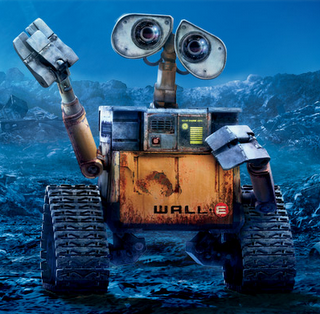
WALL-E

Copyright 2008, Walt Disney Pictures

Part of the remembrance of film in 2008, good and bad, though this series will be admittedly shortened.

What can you say about a movie whose lead, a robot, manages to be the most heartfelt and emotionally true character of the year? Is it any surprise that WALL-E, arguably the best animated film of the last ten years, is a Pixar creation? I've grown up with Pixar, having seen their first feature film, 1995's Toy Story, when I was only 10, and I find myself more eager to see their latest now than I was back then. What is more exciting for a film buff than a studio at the top of its game, and what is more exciting for that company to be expressing emotions and images rarely touched in live action?

I will be the first to admit that hearing the quick synopses of Pixar's most recent films originally filled me with great unease. Their 2006 release, Cars, while a major achievement in animation (and a great way to show off a Blu-ray system) and a hugely successful merchandising property, is the film that impresses me least. After having watched the film more than once, I can say it's grown on me, but not in the same way that any of Pixar's other releases, even Monsters, Inc., have. Part of the issue remains the derivative plotline (switch out cars for humans, and Owen Wilson for Michael J. Fox and you have Doc Hollywood), and part of it is that the film meanders, perhaps appropriate considering the moral, but still a meander.

So when I first saw that their next film was about a rat who wanted to be a chef in Paris, it didn't matter that Brad Bird, the man behind The Incredibles, was the director. All I thought was, "Can they pull it off?" My faith was bolstered in watching Ratatouille, one of last year's best. Though the entire film still works wonders for me (even its shift in focus from Remy to Linguine halfway through, much as WALL-E seems to shift), it's the review by Anton Ego that solidifies my eternal love for this movie.

I vividly remember seeing the film last year the Saturday of its opening weekend, in a theater filled with families and, obviously, many children under the age of 10. I almost wish I wasn't old enough to fully appreciate Brad Bird's philosophical musings on the nature of the critic-artist relationship masquerading as a potentially evil character reading a restuarant review. Can you imagine what the kids were thinking? I wouldn't have grasped it, and I remember thinking that was exactly the point. That Bird and company could pull it off--making an animated film that's far easier to appreciate if you're not a kid--impressed me immensely. Though The Incredibles does touch heavily on adult themes, the main idea--that greatness is suppressed in favor of mediocrity--wasn't as developed as I hoped. Of course, that idea was shifted in place of some great action sequences, so I won't complain.

It was at the screening of Ratatouille that I saw the teaser trailer for WALL-E. I knew of the movie somewhat, that it was from Andrew Stanton, who'd been with Pixar for a long time and had helmed Finding Nemo. In fact, the teaser, which gave Stanton more face time than the title character, didn't garner my whole attention and some unease until the very end, when the film's title appears onscreen and is repeated by WALL-E himself. I sat up straight in my seat and wondered. Were these guys getting in over their heads? A movie about a robot with, if not knowledge of English, a strange and possibly creepy voice? After finally seeing WALL-E, I learned to stop being uneasy. My faith was bolstered again with this journey into the future.

To humor you, let's get the plot synopsis out of the way; WALL-E is a small trash compactor robot. His mission is to clean up Earth so it can be sustainable for humans again; the humans trashed the planet and have vacated it for a cushy space station. WALL-E is the only one of his kind left and is very lonely, until he meets EVE, a probe droid sent by the humans to check on the progress of the clean up. They fall in love, WALL-E first, and he ends up chasing her back to the space station, where much action takes place.

But before that action takes place on the Axiom, the humans' space station, what magic there is and in such a desolate place. Earth in 2800 is an awful thing to look at, the biggest landfill in the world. Thanks to sloth and gluttony, there's so much trash that skyscrapers can be constructed from it. How could this not be a turn off to viewers, not only in the brown-tinged landscapes but in its message? How to place a strongly worded message about promoting environmentalism? What Stanton did was something Pixar's been looking for: a memorable character. Yes, Woody and Buzz are memorable characters, but not lovable on the same level as WALL-E, the best character they've created.

Again, this has been something they've been trying for a while. First, it was Sully in Monsters, Inc. Then, it was Dory in Finding Nemo. Mater in Cars. Excluding Brad Bird's films, where lovable is not a necessary trait, Pixar has wanted to created someone or something kids and adults could latch onto. Lo and behold, a binocular-inspired Chaplinesque robot.

His charm is what pulls us through the first 40 minutes (yes, 40; it does take just under 40 minutes for us to be introduced to the humans of the future and, thus, any real dialogue), where not only is WALL-E the main character, but he is frequently the only character. Watching a robot play with a bra, a diamond ring, and bad showtunes shouldn't work, but dammit if WALL-E isn't the elixir. When EVE comes on the scene, her realistically crabby nature at her presumably futile job is a strong contrast for WALL-E's childlike optimism and determined focus. Getting struck by lightning, having a welcome gift snubbed...nothing truly wears him down with her.

Who knows? Maybe WALL-E knows instantly that EVE is a kindred spirit (or maybe just after she attempts to blow him to bits). That EVE warms to WALL-E is part of the magic this film holds, from her initial coldness and anger to humming his favorite tune to rouse him out of his stupor. Despite the criticism leveled at the film (mainly that the humans having such a major role in the film's second half), there are few moments in film this year to rival EVE and WALL-E's last scene; the emotion there in EVE is this close to heartbreaking.

Recently, there's been talk of the film getting nominated for Best Picture at the Oscars. No, it's not likely (though not as unlikely as you may think), but it's a film that lingers far more than earlier releases from the year, and even more so than some year-end releases (I'm looking at you, Slumdog Millionaire). Love in its purest form, between robots or humans or anything else, is a powerful bond, one we can link ourselves to as strongly as we do to anything else. I'm not sure that WALL-E will get a nomination for Picture (though I'd be thrilled if it does), but I am relatively certain its message, its characters, and its many perfect scenes and sequences will be thought of fondly in years to come, more so than the live-action spectacles being offered to us as Oscar fodder.

If Pixar can impress people so thoroughly this year with a lovestruck trash compactor, perhaps they'll do the same with their next release, May's Up. You want to talk about crazy premises? How's this: a 78-year old (Ed Asner!) decides to forgo a retirement home, so he lifts his house from its roots with thousands of balloons and flies to South America to fulfill his late wife's wish. Consider me psyched, and here's why: it's not that this is from Pixar...it's that I wonder if this film could be equal to or better than Ratatouille and WALL-E. Is it even possible? One can only, as WALL-E does every night, hope beyond hope and dream.

Four stars out of four